Kylian Mbappe, Real Madrid and LaLiga have all apologised to China after a clip of the Real Madrid player joking about a meme resembling Mao Zedong set off a backlash that cost him brand deals and took LaLiga matches off Chinese state television.
The Apologies
Mbappe apologised on Tuesday 27 October, The Guardian reported. He said he was “sincerely sorry” for his “ill-judged” comment, according to BBC News.
In his apology, Mbappe said: “My comment was ill-judged, and I now understand that it hurt many people in China”, The Guardian reported.
LaLiga also apologised. In a statement, the league said it “deeply regrets the offence that Kylian Mbappé’s recent comments have caused among Chinese fans”, according to The Guardian.
Real Madrid followed on Wednesday 28 October, apologising “to the Chinese people for any offence caused”, The Guardian reported.
The China Football Association lodged a “stern protest” with Real Madrid, according to The Guardian.
What Mbappe Said About the Mao Meme
Fans found a clip in which Mbappe joked about the meme that makes him “laugh the most”, BBC News reported.
In the meme, his face is superimposed on a “Chinese dictator” resembling Mao Zedong. He did not name Mao, according to the BBC.
Mbappe has been nicknamed “the dictator” since his Paris Saint-Germain days, a joke about his influence at the club, The Guardian reported.
The row came as Mbappe missed out on the Ballon d’Or, according to The Guardian.
Sponsors Gone and LaLiga Off Air
Chinese brands cut ties with him one by one, BBC News reported.
China Media Group, the parent of CCTV, suspended broadcasts of LaLiga matches. As at 29 October, it had yet to say whether broadcasts would resume, according to the BBC.
Mark Dreyer, author of Sporting Superpower, said Mbappe’s commercial deals could be worth “as much as $30m (£22.6m) per year”, The Guardian reported.
There is a precedent for a long shutdown. The NBA’s pre-season games were shut out of China for six years after Houston Rockets general manager Daryl Morey backed Hong Kong pro-democracy protests in 2019, according to The Guardian.
Beijing’s Response
China’s foreign ministry responded to the row. A spokesperson said, according to BBC News: “Words and actions that hurt the feelings of the Chinese people will naturally be met with joint opposition from all sectors of Chinese society.”
On Wednesday 28 October, foreign ministry spokesperson Guo Jiakun addressed Mbappe’s apology. He said, according to The Guardian: “We take seriously the apology the individual concerned has made.”
None of the apologies, nor the foreign ministry statement, mentioned Mao directly, BBC News reported.
Most Chinese coverage did not say what Mbappe had said, according to The Guardian, and one hashtag on his apology passed 600m views.
Dreyer said, according to The Guardian: “It doesn’t sound like it’s an instant ‘all is forgiven’. But it sounds like they’re going to be a little bit more, for want of a better word, reasonable.”
Why Mao Still Matters in China
Mao founded the People’s Republic and died in 1976, BBC News reported.
The Great Leap Forward led to a famine that killed tens of millions, according to the BBC.
The Communist Party’s verdict is that his achievements outweigh his mistakes, the BBC reported.
Mobo Gao is a professor of Chinese studies at Adelaide University.
“For the majority of the [Chinese] people, Mao was and is still not seen as negatively as it is believed in the west,” he said, according to The Guardian.
Buzzline’s football coverage includes the Socceroos going out of the World Cup after a penalty shootout loss to Egypt in Dallas.
More football news is in Buzzline’s Football section.
Sources: BBC News, “China made Real Madrid’s Mbappé apologise over Mao remark”, 29 October 2026 (https://www.bbc.com/news/articles/cm3wv36d603yo); The Guardian, “Kylian Mbappé’s China crisis shows how sensitive Mao’s legacy remains”, 28 October 2026 (https://www.theguardian.com/football/2026/oct/28/kylian-mbappe-china-crisis-shows-how-sensitive-maos-legacy-remains)
Photo: Ank Kumar, CC BY-SA 4.0, via Wikimedia Commons.
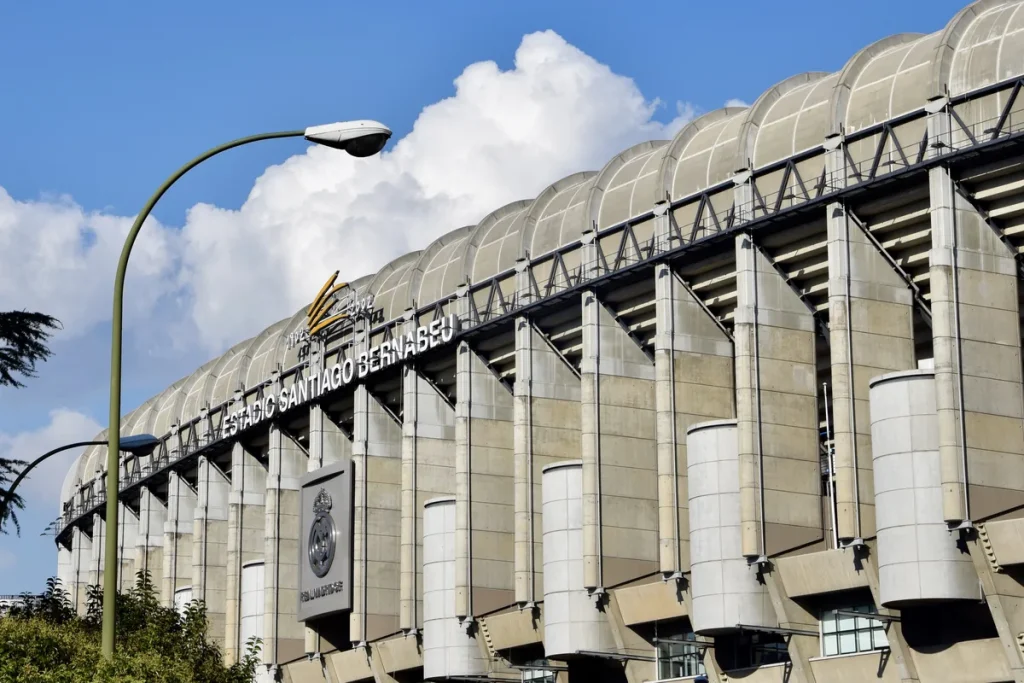
Real Madrid’s Santiago Bernabeu stadium in September 2014, shown as an illustration rather than a scene from the story.