Right-wing senator Flavio Bolsonaro has won the first round of Brazil’s presidential election, held on Sunday 4 October. He finished just ahead of President Luiz Inacio Lula da Silva, and the two will face each other in a run-off on 25 October.
Bolsonaro won about 47 per cent of the vote, the BBC reported, to about 45 per cent for Lula. Al Jazeera put the count at 47 per cent to 44.9 per cent, with nearly 99 per cent of votes reported at the time.
Neither candidate reached 50 per cent, the threshold for winning outright, so the top two go to a second round.
Bolsonaro, 45, is the eldest son of former president Jair Bolsonaro. The elder Bolsonaro is serving a 27-year prison sentence for plotting a coup after he lost the 2022 election.
Against the Polls
Polls before the vote had Lula slightly ahead, both the BBC and Al Jazeera reported. The first-round result turned that order around.
Lula, 80, is running for a fourth, non-consecutive term. He had expected to settle it on Sunday. “I admit I was convinced I would win in the first round,” he said, according to the BBC.
By Al Jazeera’s tally, Bolsonaro received about 56 million votes and Lula almost 53 million, with the count close to complete.
“The protest vote foreshadows what is to come in the run-off,” political analyst Rafael Favetti told Reuters, in comments reported by Al Jazeera.
Beyond the Presidency
The right also did well in other races on Sunday. In results so far, Bolsonaro’s Liberal Party (PL) had the most governors, senators and federal deputies elected, according to the BBC.
Al Jazeera reported that right-wing parties led by the PL performed strongly in both houses of Congress. Brazil’s Congress has two chambers, the Chamber of Deputies and the Federal Senate.
The Pitch for Round Two
Bolsonaro looked ahead to the second round. “I am very happy with the real possibility that, three weeks from now, Brazil will give a definitive answer by choosing a modern government,” Bolsonaro said, in remarks reported by AFP and carried by the BBC.
He has pledged that, if elected, he would grant an amnesty to his father and to supporters responsible for the riots of 8 January 2023, the BBC reported.
Lula, also quoted by the BBC, used the language of football to describe the weeks ahead: “The game is about to start. We are in extra time. In extra time, we will win over the Brazilian people.”
Three Weeks to 25 October
The run-off sets a right-wing senator, the son of a jailed former president, against a leftist sitting president seeking a fourth term.
Separately, the president of Brazil’s supreme electoral court said no evidence of international interference had been found, the BBC reported.
On the first-round figures, about 47 per cent to about 45, neither side starts the second round with much room. Both campaigns now have three weeks before polling day, and the BBC and Al Jazeera each present it as a close contest.
Elsewhere in South America, Buzzline reported on 2 October that an alleged WA drug kingpin known as “The Kid” had been arrested in Colombia.
Sources: BBC News, “Right-wing Flávio Bolsonaro wins first round of Brazil election”, 4 October 2026 (https://www.bbc.co.uk/news/articles/ck1l34ed592no); Al Jazeera, “Brazil’s presidential race: Three key takeaways from the first round”, 5 October 2026 (https://www.aljazeera.com/news/2026/10/5/brazils-presidential-race-three-key-takeaways-from-the-first-round)
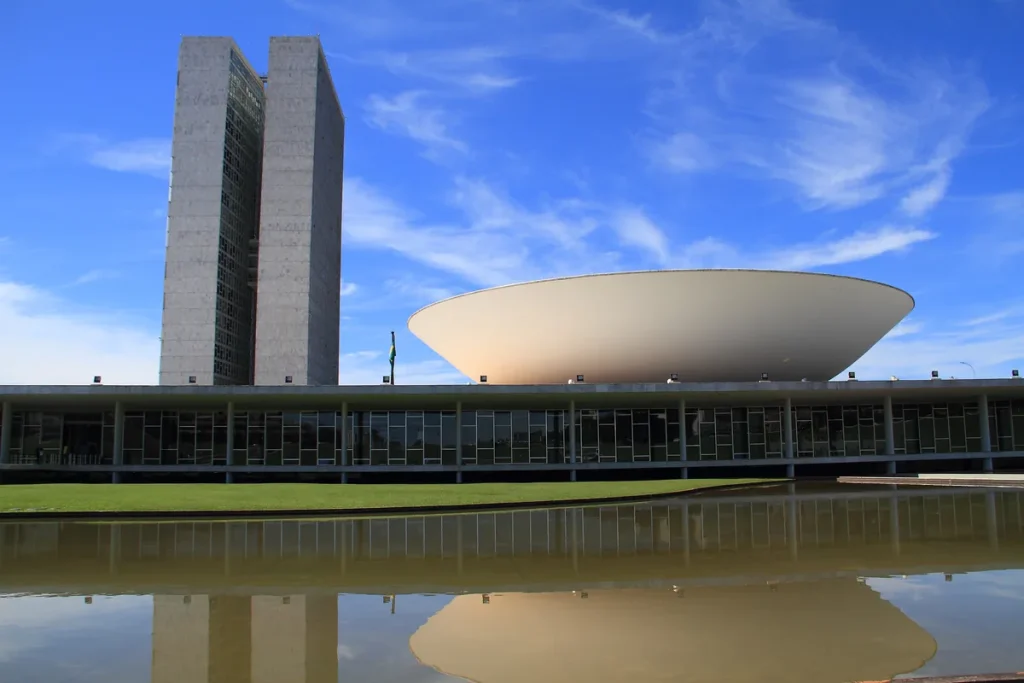
Photo: Marinelson Almeida, CC BY 2.0, via Wikimedia Commons.
Brazil’s National Congress in Brasilia, photographed in 2015. This photograph is illustrative; it was not taken during the 2026 election.