Australia’s deaths are projected to outnumber its births from the 2060s, according to Treasury’s seventh Intergenerational Report, which puts a date on the crossover for the first time. The document, released on 21 September, is the five-yearly long-term forecast for the population and the budget, and its projections run to 2065-66. It sets out an older and slower-growing country, one that leans on migration and on productivity to carry the costs of the decades ahead, with a population that reaches about 39 million by the mid-2060s (The Conversation).
The Finding
The shift comes from lower fertility and an ageing population, and it shows up in the country’s age structure rather than in any single year’s numbers. Australia joins Japan, Italy and South Korea in passing the point where natural increase stops, when births no longer exceed deaths. Migration is the difference between growth and decline, and the report notes it has “moderated the pace of ageing” across the years the projections cover. ABC News reported the date the report gives for the crossover, the first the series has given, together with the figures that carry it: lower fertility, longer lives, and a population growing older from here.
The Numbers
ABC News set out the ageing arithmetic behind the projections. The median age reaches 45 by 2066, up from 38.5 now. The number of people over 65 grows about eight times faster than the group aged 0 to 20. The old-age dependency ratio, which measures how many people of working age sit behind each older Australian, rises from roughly 29 per cent to about 39 per cent by 2066. The number of people aged 85 and over triples over the same 40 years, and each of them costs the budget about as much as four working-age people contribute. Against that bill, the report counts about a 1 per cent gain from people working later in life and from higher female participation.
The Framing
Treasury’s summary organises the next 40 years around five transitions: the AI revolution, geopolitical fragmentation, the energy transition, ageing and the care economy, and industrial transformation. The report adds a chapter on intergenerational equity, which covers how costs and opportunities fall across the generations alive now and the generations to come. For younger Australians, the chapter centres on building wealth and buying homes, which makes housing affordability the place where the projections meet the present debate. The productivity story rests on AI, and The Conversation reported that the report casts it as “a defining influence” on the decades ahead: the gains it projects arrive only if the adoption and the investment the report assumes come through.
What Chalmers Says
The Treasurer, Jim Chalmers, fronted the release. He said falling birth rates were among the biggest changes since the last report, with the government expecting “fertility rates to fall further and faster”. He noted that Australia crosses the deaths-over-births threshold decades later than Japan and South Korea, which he called “really quite good” economies (ABC News).
The Reaction
The migration numbers drew the sharpest political responses. Former home affairs secretary Mike Pezzullo argued for long-term net overseas migration of about 235,000 a year, and cautioned against letting catch-up migration become “baked in forever”, in comments reported by News24. Business Council chief executive Bran Black said the starting point should not be the migration number but “what are the skills we need”, the ABC reported. One Nation pushes emigration and a cap of 130,000 a year on the intake, the Coalition has set no target and ties migration to the pace of housing construction, and the government’s recent measures aim at 225,000 by 2028, all as reported by the ABC. The report takes no side in the migration argument.
The Long View, and Its Limits
The report is a set of projections, not policy. No tax change, no migration target and no spending decision follows from it automatically. The figures are projections rather than predictions, and they put dates and numbers on the pressures: the date for deaths over births, the ageing bill, and a productivity bet that has to be earned. What it does not do is choose. Every hard choice it describes is left to future budgets, and to the governments that write them.
Sources: Commonwealth Treasury, 2026 Intergenerational Report, 21 September 2026; ABC News, “Deaths forecast to outpace births in Australia for first time in Intergenerational Report”, 21 September 2026; The Conversation, “Australia set for 39 million people by mid-2060s, but slower population growth”, 20 September 2026
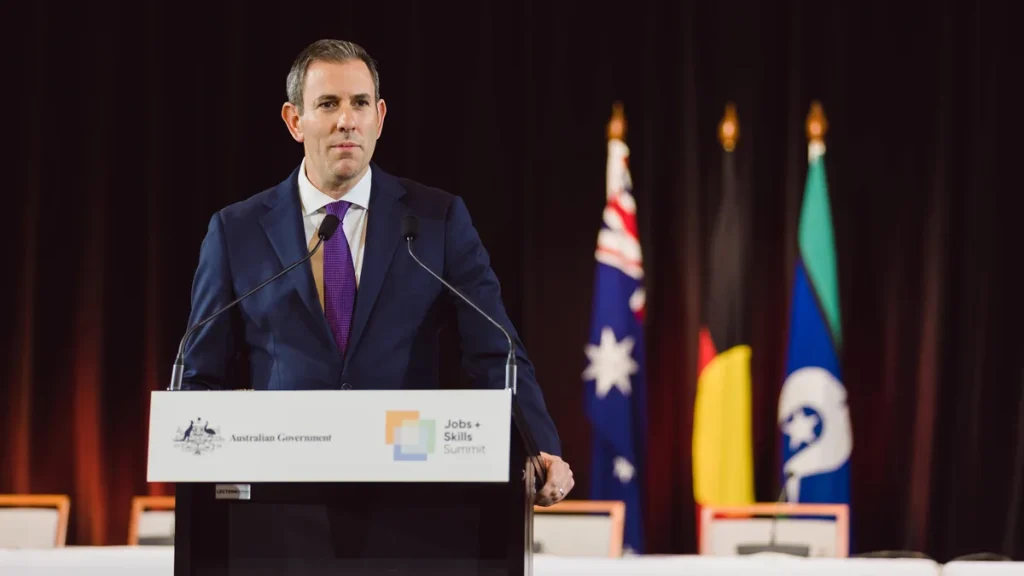
Photo: Department of the Treasury, Commonwealth of Australia, CC BY 4.0, via Wikimedia Commons.
Treasurer Jim Chalmers speaking at the Jobs and Skills Summit in Parliament House, Canberra, in September 2022. Chalmers released the seventh Intergenerational Report in September 2026; this photograph is from 2022.