Australia and India have finalised an Administrative Arrangement that opens the way for long-term Australian uranium exports to India for exclusively peaceful purposes. The two governments announced the arrangement during the third Australia-India Annual Summit in Melbourne, and it sits under the 2014 civil nuclear cooperation agreement between the two countries. It operationalises that agreement: it gives both governments the terms on which uranium supply can proceed. All material supplied under the arrangement falls under International Atomic Energy Agency safeguards, the international verification regime for civil nuclear material. The arrangement sets terms for supply rather than a schedule, and no volumes, prices or delivery dates were announced at the summit.
Uranium exports have been the slowest part of the nuclear relationship. Australia has sent only limited uranium to India since the 2014 agreement was signed, and proliferation concerns have held exports back, as reported. India’s stated goal is 100 gigawatts of nuclear capacity by 2047, as reported. The arrangement is meant for supply over decades rather than a single shipment.
Prime Minister Narendra Modi called it “an important agreement today on nuclear energy”. Prime Minister Anthony Albanese said the arrangement would help raise the share of non-fossil-fuel power capacity. Both spoke after the signing on 9 July, the middle day of Modi’s three-day visit.
The leaders met for the third annual summit and issued the outcomes as a joint statement of 28 paragraphs. Alongside the uranium arrangement, the two governments signed a new Joint Declaration on Defence and Security Cooperation. Under the declaration, the defence relationship gains an annual Defence Ministers’ Dialogue and an India-Australia Maritime Security Collaboration Roadmap. Australia’s Maritime Border Command and the Indian Coast Guard will work together under a memorandum of understanding, and the two governments will negotiate a second memorandum covering defence articles and services. An Indian military instructor will take up a post at the Australian Defence College in 2028-29, and Australia will host the fourth General Rawat Young Officers’ Exchange.
Beyond defence, a run of agreements covers critical minerals, trade, energy, cyber, technology and space. The two governments backed investment in critical minerals projects and supply chains. Trade talks will continue on the Comprehensive Economic Cooperation Agreement, which builds on the Economic Cooperation and Trade Agreement already in place, and on non-tariff barriers. A separate joint statement deals with energy security, and an Australian, Canadian and Indian memorandum covers technology and cyber cooperation. For space, Australia will host a temporary tracking terminal on the Cocos Keeling Islands to support India’s Gaganyaan human spaceflight programme.
Education and skills agreements run alongside the trade and defence strands. Flinders University will open a campus in Bengaluru and Victoria University one in Gurugram, and a mining skilling centre will be established in Bhubaneswar. The joint statement also records the repatriation of cultural artefacts and ancestral remains, along with $10 million for the Maitri grants run by the Centre for Australia-India Relations.
The summit’s economic numbers sit in the statement too. India is Australia’s fifth-largest trading partner, with two-way goods and services trade of A$54.4 billion in 2024-25, as reported. The figure is the starting point for the continued work on trade.
The statement runs across civil nuclear energy, defence, trade, critical minerals, space and education. What it does not contain is a delivery schedule. The uranium arrangement is enabling machinery: it names no volume, price or delivery date. What changes is process, giving exporters a route to long-term supply under safeguards. The defence declaration sets out how cooperation will be run rather than what either side will do next.
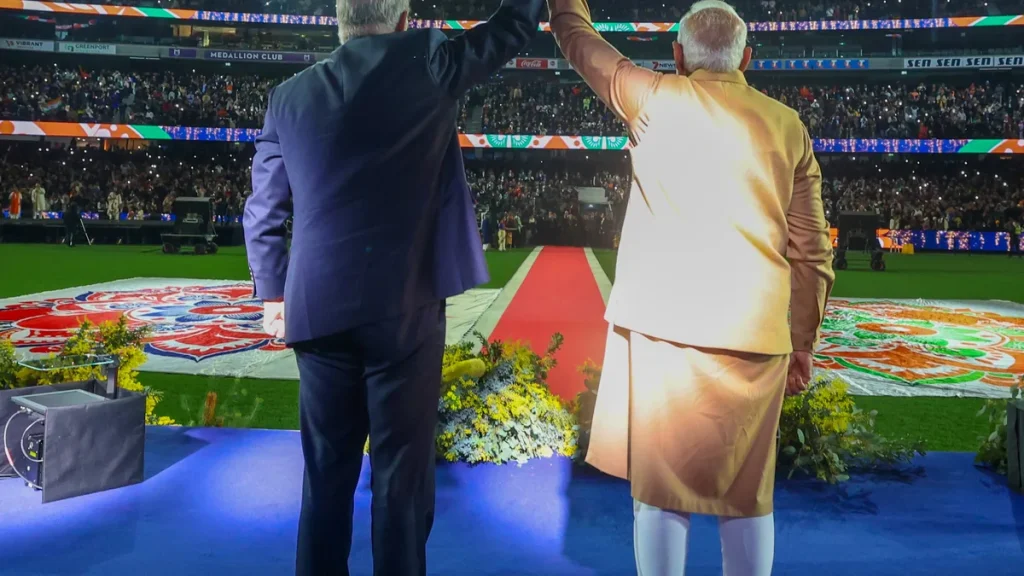
Modi’s visit ran from 8 to 10 July, hosted by Albanese. Melbourne was the centre of it: he arrived on 8 July, met Albanese the following day, when the two governments signed and announced the agreements, and addressed the Melbourne Meets Modi community event at Marvel Stadium that evening. The community event came after the day’s meetings and was the public set piece of the three-day visit, and tens of thousands of people attended. He left for New Zealand on 10 July.
After the Summit
What is now in place is a set of documents: an arrangement to ship uranium, a declaration to work through, and officials on both sides to carry the follow-through. Officials have set no delivery timetable and agreed no volumes. The next stage of the relationship, on this evidence, is administrative rather than ceremonial.
Sources: Prime Minister of Australia, “Third Australia-India Annual Summit Joint Statement”, 9 July 2026; ABC News, “India and Australia strike new deals as Modi visits Melbourne”, 9 July 2026; ABC News, “Narendra Modi given rapturous welcome as he addresses thousands in Melbourne”, 10 July 2026
Photo: Prime Minister’s Office, India, GODL-India, via Wikimedia Commons.
Prime Minister Narendra Modi and Prime Minister Anthony Albanese at the Melbourne Meets Modi community event at Marvel Stadium, Melbourne, on 9 July 2026.