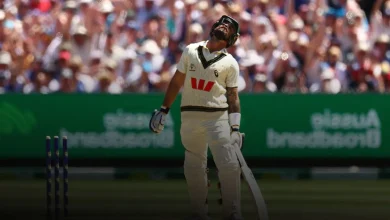

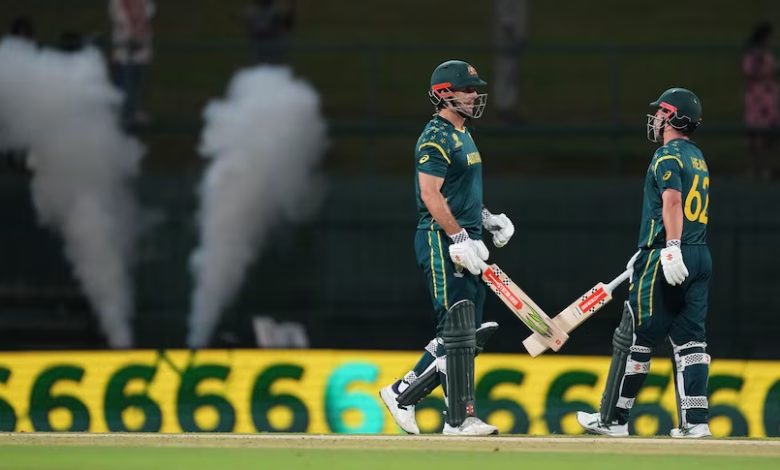
- Australia finished its ICC Men’s T20 World Cup campaign with a dominant nine-wicket victory over Oman national cricket team in Kandy, chasing 105 in just 9.4 overs.
Australia closed its ICC Men’s T20 World Cup campaign with a dominant nine-wicket victory over Oman national cricket team in Kandy, Sri Lanka, delivering its most convincing performance of the tournament. However, the comprehensive win could not alter the overall outcome, as earlier defeats had already eliminated Australia from advancing beyond the group stage.
The match, played at the Pallekele International Cricket Stadium on 21 February 2026, highlighted Australia’s quality and depth but also underscored the inconsistency that defined its disappointing tournament run. Led by captain Mitchell Marsh, Australia chased down a modest target of 105 in just 9.4 overs, recording one of the fastest chases in the competition.
Australia’s early exit confirms a rare global setback
Australia entered the tournament as one of the strongest contenders, having won the ICC Men’s T20 World Cup in 2021 and consistently ranked among the top teams in the ICC T20 International standings. According to the International Cricket Council, Australia was ranked inside the top five in the T20I team rankings prior to the tournament, reflecting its strong recent record.
However, back-to-back defeats against Zimbabwe national cricket team and Sri Lanka national cricket team ended Australia’s hopes of progressing. The losses exposed weaknesses in Australia’s batting consistency and bowling execution during crucial moments.
Captain Mitchell Marsh later described the campaign as a missed opportunity, noting that the squad had spent nearly two years preparing for the event but failed to perform when it mattered most.
Australia’s elimination marked one of the few occasions in recent years that the team failed to reach the knockout stages of a major ICC limited-overs tournament.
Oman bowled out cheaply after disciplined Australian bowling
Australia’s bowling attack delivered its most effective performance of the tournament, dismissing Oman for just 104 runs in 16.5 overs. The early breakthrough came immediately when fast bowler Xavier Bartlett removed opener Aamir Kaleem with the very first delivery of the match.
This early success set the tone for the innings, as Australia’s bowlers maintained pressure throughout. Bartlett finished with figures of 2 wickets for 27 runs from his four overs, combining pace and accuracy to disrupt Oman’s batting order.
The standout performer with the ball was leg-spinner Adam Zampa, who produced a match-winning spell of 4 wickets for 21 runs. Zampa’s performance demonstrated his continued importance as Australia’s primary spin bowler in limited-overs cricket.
Six Omani batters were dismissed by being bowled, highlighting Australia’s precise line and length. Oman struggled to build partnerships and failed to generate sustained momentum at any stage of their innings.
Bowling Performance Comparison Chart
| Team | Overs Faced | Runs Scored | Wickets Lost | Run Rate | Top Bowling Performance |
|---|---|---|---|---|---|
| Oman | 16.5 overs | 104 runs | 10 wickets | 6.17 | Adam Zampa: 4/21 |
| Australia | 9.4 overs | 108 runs | 1 wicket | 11.17 | Chase completed comfortably |
Source: https://www.abc.net.au/news/2026-02-21/t20-world-cup-australia-vs-oman-live-blog/106371016
Source: https://www.icc-cricket.com
Marsh leads aggressive chase with captain’s innings
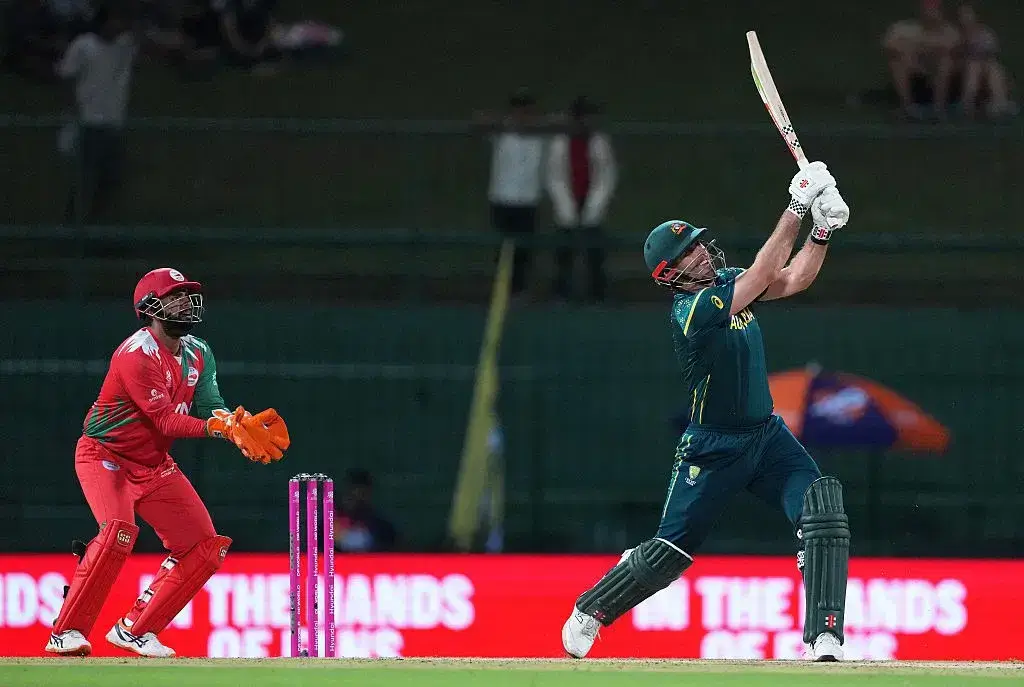
Australia’s batting response was immediate and aggressive. Mitchell Marsh played one of the finest innings of the tournament, scoring an unbeaten 64 runs from just 33 balls. His innings included seven fours and four sixes, demonstrating both timing and power.
Marsh was supported by opener Travis Head, who contributed 32 runs from 19 balls. Head’s attacking approach helped Australia reach the target quickly and ensured there was no opportunity for Oman to regain control.
The pair added 95 runs for the first wicket, effectively ending the contest within the powerplay overs.
Head was dismissed shortly before the target was reached, allowing wicketkeeper-batter Josh Inglis to score the winning runs with an unbeaten 12 off six balls.
Batting Performance Chart
| Player | Runs | Balls Faced | Strike Rate | Boundaries |
|---|---|---|---|---|
| Mitchell Marsh | 64 not out | 33 | 193.94 | 11 |
| Travis Head | 32 | 19 | 168.42 | 6 |
| Josh Inglis | 12 not out | 6 | 200.00 | 2 |
| Oman Total | 104 all out | 101 balls | 103.00 | — |
Source: https://www.espncricinfo.com
Source: https://www.icc-cricket.com
Australia’s campaign reflects inconsistency despite strong squad
Australia’s squad featured experienced international players with strong T20 records. Mitchell Marsh has maintained a T20I strike rate above 135 during his international career, while Adam Zampa remains Australia’s leading wicket-taking spinner in T20 Internationals, with over 100 wickets as of early 2026.
Despite this, the team struggled with consistency during the tournament.
In modern T20 cricket, small margins often determine results. Australia’s losses to Zimbabwe and Sri Lanka involved missed chances, inconsistent batting partnerships, and ineffective bowling during key overs.
Cricket analysts noted that while Australia’s overall squad remains among the strongest globally, the team must adapt quickly to evolving T20 strategies, including aggressive powerplay scoring and specialised bowling roles.
Australia’s historical T20 record remains strong
Australia remains one of the most successful teams in international cricket history. The team won its first ICC Men’s T20 World Cup title in 2021 and has consistently reached knockout stages in ICC tournaments across formats.
According to ICC historical records:
| Tournament | Australia Result |
|---|---|
| ICC T20 World Cup 2021 | Champions |
| ICC T20 World Cup 2022 | Super 12 stage |
| ICC T20 World Cup 2024 | Semi-finals |
| ICC T20 World Cup 2026 | Group stage exit |
Source: https://www.icc-cricket.com
The early exit in 2026 represents a setback but not a long-term decline. Australia continues to produce world-class players and remains competitive in global cricket.
Positive signs emerge despite tournament disappointment
Although Australia failed to qualify for the knockout rounds, the commanding win over Oman provided some positives.
The performance demonstrated the team’s ability to dominate opposition when executing plans effectively. The bowling unit delivered discipline, while the batting lineup showed its capability for rapid scoring.
Mitchell Marsh’s leadership and batting form were among the few consistent strengths during the tournament.
The match also reinforced Australia’s depth, with emerging bowlers like Xavier Bartlett showing potential at the international level.
Looking ahead to future international competitions
Australia’s focus will now shift to upcoming bilateral T20 series and preparation for future ICC events, including the next T20 World Cup cycle.
The team management is expected to review the campaign closely, identify tactical weaknesses, and strengthen squad depth.
While the victory over Oman ended Australia’s tournament on a positive note, it also served as a reminder of the high standards required to succeed in modern T20 cricket.
For Australia, the performance showed both its strengths and the challenges ahead as it seeks to return to the top of world cricket.