A Russian jet-powered drone struck a crowded platform at the main railway station in the Ukrainian city of Dnipro on Thursday 29 October. The dead numbered at least 14, officials said, as at 30 October.
Dnipropetrovsk regional head Oleksandr Hanzha said at least 14 others were wounded, including an 11-year-old boy, BBC News reported.
It was one of several attacks reported by BBC News on 29 October, and it came as strikes on Ukraine’s railways have risen in 2026, according to figures from the state rail operator.
Trains at the Platform
Ukraine’s state railway operator, Ukrzaliznytsia, said a passenger train headed for Zaporizhzhia was at one of the platforms when the drone hit.
Dnipro Mayor Borys Filatov called the attack a tragedy. He said a drone had hit an electric civilian train.
Ukraine’s president, Volodymyr Zelensky, said “the Russians used a drone to attack a platform where a regular commuter train and a regular passenger train were standing.”
A Warning Before the Strike
An elevated threat level had been announced in Dnipro ahead of the strike, according to the railway chief, Oleksandr Pertsovsky.
“But unfortunately there were still a large number of people on the platform”, he said, BBC News reported.
The UN Condemns the Attack
Matthias Schmale, the UN’s Humanitarian Coordinator for Ukraine, condemned the attack in a statement. UN News, reporting his statement on 29 October, gave an earlier count of at least 13 civilians killed and 10 injured, before officials raised the toll.
In the statement, Schmale described the people who had been on the platform.
“Civilians preparing for a trip, welcoming or bidding farewell to loved ones faced death and devastation,” he said.
He said displaced people and humanitarian workers at a transit centre at the station were left in shock.
“The images from Dnipro cannot become another story that fades from attention. Behind every casualty is a person, a family and a future changed forever,” he said.
Schmale added: “It cannot be repeated often enough that civilians and civilian infrastructure are protected under international humanitarian law.”
Moscow and the Sanctions Question
Russia’s military did not publicly comment on the Dnipro strike, BBC News reported. Moscow denies deliberately targeting civilians, and its defence ministry says its attacks on railways target infrastructure used to move military personnel and equipment.
Zelensky called for further US, European and G7 sanctions. He also repeated his criticism of a deal struck earlier in October between Donald Trump and Vladimir Putin that eased some sanctions on Moscow. Buzzline has set out what is at stake for Congress when Americans vote in the US midterms on 3 November.
Attacks on the Railways
Of the 521 locomotives hit since February 2022, almost 60% were hit in 2026, according to Ukrzaliznytsia figures reported by BBC News.
Attacks on railway facilities rose from 1,206 in 2025 to 1,700 in 2026, as at the BBC’s report on 29 October.
Other cities were also hit. In Chernihiv, two girls aged 15 were killed and at least 25 people injured in a missile attack, and in Kremenchuk a drone killed three people and injured 28, BBC News reported.
A day of mourning was declared for Chernihiv and Dnipro on Friday 30 October.
A Ceasefire Elsewhere, Due to End on 1 November
In the Russian-occupied town of Oleshky, a local ceasefire was holding into a third day, BBC News reported on 29 October.
The truce was brokered by US First Lady Melania Trump and announced by the White House on 23 October, according to UN News. It is due to end on the evening of 1 November.
More world news is in Buzzline’s International section.
Sources: BBC News, “Russian drone attack on Ukrainian train station kills at least 14, officials say”, 29 October 2026 (https://www.bbc.co.uk/news/articles/c9p8gdlz1p2ko); UN News, “Russia drone strike on Ukrainian railway station kills 13”, 29 October 2026 (https://news.un.org/en/story/2026/10/1168702)
Photo: Posterrr, CC BY-SA 4.0, via Wikimedia Commons.
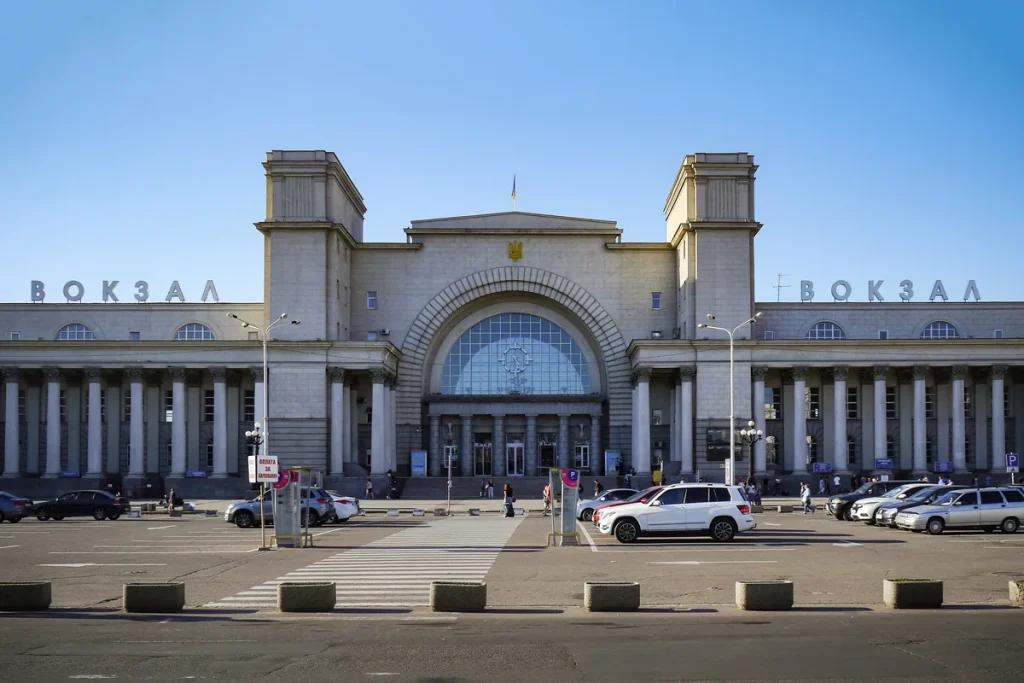
Dnipro’s main railway station, seen from the station square in August 2020, years before the strike.