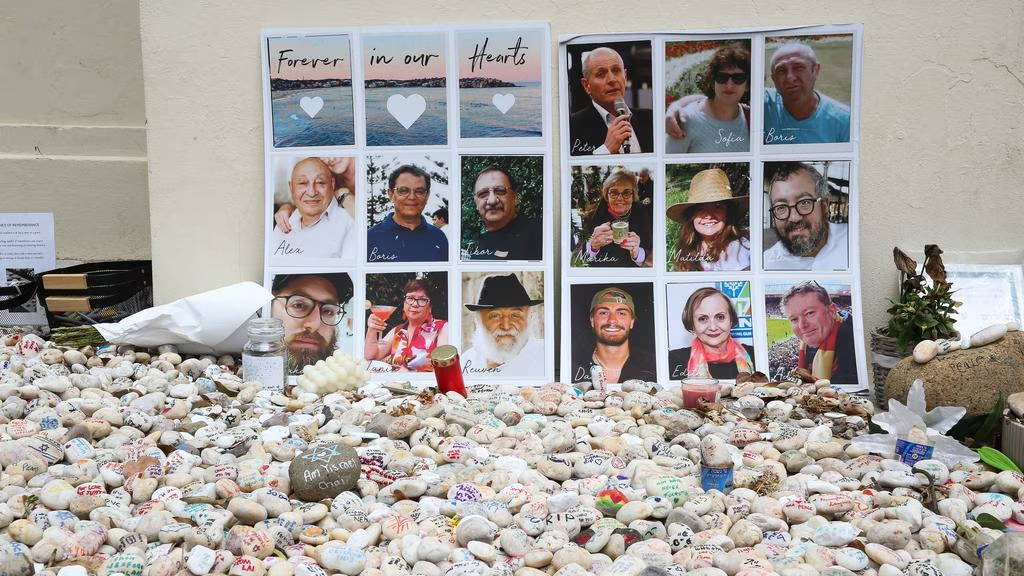
A royal commission examining the deadly Bondi Beach terror attack has heard that the majority of victims were killed within the first half-minute of the assault, highlighting the speed and devastation of one of Australia’s worst recent extremist incidents.
The inquiry into the December 14, 2025 attack at the Chanukah by the Sea event in Sydney resumed this week with detailed evidence from security officials, police and intelligence agencies. The hearing focused heavily on the timeline of the attack, the national terrorism threat environment, and growing concerns around anti-Semitism and violent extremism in Australia.
Fifteen people were killed and dozens injured during the attack at Bondi Beach. Authorities allege 24-year-old Naveed Akram participated in what investigators described as an ISIS-inspired terrorist assault. He has been charged with 59 offences. His father, Sajid Akram, was shot dead by police at the scene.
Counsel assisting the commission, Richard Lancaster SC, told the hearing that 11 people were shot within the first 29 seconds after the gunmen began firing. Ten of those victims died almost immediately.
The evidence painted a picture of an attack that unfolded with extraordinary speed, leaving little opportunity for those attending the event to react or escape.
Attack Unfolded Within Minutes
According to the commission, four police officers were already monitoring Archer Park during the Chanukah by the Sea gathering when the shooting began. Within five minutes, the police presence increased to 11 officers as emergency responses intensified across the area.
The commission heard that one of the gunmen was killed by police approximately eight minutes after the attack started, while Naveed Akram was wounded and arrested shortly afterwards.
Lancaster described the incident as a “surprise attack”, stating there was no intelligence warning indicating an imminent threat against the Jewish community event before the shooting occurred.
“There is no evidence to suggest any intelligence or law enforcement agency had information there may be an armed attack,” the inquiry was told.
The rapid sequence of events has raised fresh questions about preparedness for attacks targeting crowded public gatherings and religious celebrations.
Australia’s Terror Threat Level Under Scrutiny
ASIO Director-General Mike Burgess appeared before the commission and explained how Australia’s national terrorism threat level had changed in the years leading up to the Bondi attack.
According to Burgess, the threat level stood at “probable” in November 2022 before later being lowered to “possible”. In August 2024, however, the level was raised again to “probable”.
Burgess explained that the classification indicated there was a greater than 50 per cent likelihood of a terrorist act or advocacy of terrorism occurring within a 12-month period.
Australia Terror Threat Timeline
| Year | Threat Level | Assessment |
|---|---|---|
| 2022 | Probable | Higher likelihood of terror activity |
| 2023 | Possible | Reduced immediate concern |
| 2024 | Probable | Increased concern over extremist activity |
| 2025 | Probable | Threat environment remained elevated |
The inquiry also heard that ASIO shifted more resources towards foreign interference and domestic extremist threats from 2024 onwards.
Despite concerns about growing extremist activity, Burgess maintained that ASIO’s funding and staffing levels were sufficient during the period leading up to the Bondi attack.
“In retrospect, I still think that our resourcing was sufficient for the problems we face,” he told the commission.
However, he acknowledged the agency remained stretched as extremist threats continued evolving across Australia.
Rise in Anti-Semitic Incidents Across Australia
Much of the commission’s hearing focused on the rise of anti-Semitism following the October 7 Hamas attacks on Israel and the growing security concerns surrounding Jewish communities in Australia.
Burgess said authorities witnessed people openly celebrating the Hamas attacks, followed by threatening and intimidating behaviour targeting Jewish Australians throughout 2023 and 2024.
The inquiry heard that incidents escalated from online hostility and hate speech into direct threats against people, businesses and places of worship.
Australian Federal Police Assistant Commissioner Stephen Nutt told the commission that anti-Semitic behaviour had become increasingly visible and aggressive in public spaces.
He pointed to growing displays of banned extremist symbols and gatherings involving support for organisations such as Hamas and Hezbollah.
Reported Anti-Semitic and Hate Crime Trends
| Incident Type | Reported Figures |
|---|---|
| AFP reports linked to anti-Semitism since Operation Avalite launch | 166 |
| Hate crime incidents across all victim groups in 2020 | 8% |
| Hate crime incidents across all victim groups in 2025 | 30% |
| Reported hate crime incidents against Jewish Australians in Q3 2023 | 43 |
Operation Avalite was established in 2024 to investigate threats and violence directed towards Jewish Australians and parliamentarians. Officials told the commission there was “no doubt” anti-Semitism had escalated significantly in recent years.
The commission also examined the discovery of a caravan in Dural in 2025 containing explosives and anti-Semitic material. Authorities later described the incident as part of a fabricated terrorism plot, but police acknowledged it contributed to fear within Jewish communities.
Crowded Public Events Viewed as Vulnerable Targets
NSW Police Assistant Commissioner Leanne McCusker told the inquiry that concerns regarding anti-Semitic violence had been intensifying before the Bondi attack.
Internal NSW Police risk assessments presented during the hearing identified crowded places and religious gatherings as particularly attractive targets for extremist violence.
The documents, prepared in August 2024, warned that crowded venues in New South Wales were likely targets for future terrorist attacks.
McCusker also confirmed police had recorded a sharp increase in hate crime reports over recent years, with incidents rising significantly between 2020 and 2025.
Security experts appearing before the commission said the challenge facing law enforcement agencies was not simply responding to organised terrorism, but also dealing with rapidly evolving extremist ideologies influenced by international conflicts and online radicalisation.
Inquiry Continues Into Security Failures and Prevention
The royal commission is expected to continue examining whether more could have been done to prevent the Bondi attack or improve protection at high-risk public events.
The hearings are also likely to influence future discussions around national security policy, counter-terrorism operations and community safety measures in Australia.
For families of the victims, however, the focus remains on the devastating human toll of an attack that unfolded in less than half a minute.