Navi Pillay, the South African jurist awarded the 2026 Nobel Peace Prize on Friday, has called new US sanctions on the International Criminal Court “unheard of” and “unacceptable”.
She made the remarks on Saturday, speaking via video link to an event at the Nobel Peace Center in Oslo, the BBC reported.
“Most importantly, sanctions have been announced by one country against the judges, just for the judicial orders they issue. This is unheard of, unacceptable,” Pillay said.
The sanctions were announced hours after the prize.
A Prize for International Law
The Norwegian Nobel Committee awarded the prize to Navanethem “Navi” Pillay “for her efforts to promote peace and international law”, according to its announcement.
The announcement also sets out her career. Pillay has served as a judge on the High Court in South Africa, the International Criminal Tribunal for Rwanda and the ICC. She was UN High Commissioner for Human Rights, and until recently she chaired the UN commission of inquiry on the Occupied Palestinian Territory. She is now a judge at the International Court of Justice in the case where Myanmar is accused of genocide.
Pillay is 85. The BBC reported that she is South Africa’s fifth peace laureate.
The commission she chaired concluded last year that Israel had committed genocidal acts in Gaza, the Guardian reported. Israel has rejected the findings, according to SBS News.
When she received the prize, Pillay referred to the US president. “If you clap a little bit more I may share this prize with Trump,” she said, the BBC reported.
What the Sanctions Do
According to the BBC, the new US measures target the court itself as an institution, and they include a ban on US entities transacting with it.
Washington had already sanctioned 17 ICC judges and officials before this step. Some of the new measures will not take effect until a six-month grace period has passed, the BBC reported.
“Either the ICC will end its threats, or we will end the ICC,” US Secretary of State Marco Rubio said, as quoted by SBS News.
Trump has also criticised the prize. He said it had been “forever discredited”, SBS News reported.
“This is an indelible stain on the country of Norway and those people that made such a disgraceful and embarrassing decision,” Trump said, as quoted by SBS News.
Wider Criticism
The ICC said in a statement that the sanctions were “an attempt to obstruct the course of justice and to prevent the court from doing what it was created to do”, the Guardian reported.
UN Secretary-General Antonio Guterres also criticised the decision, according to the BBC. He described it as “a serious blow to our collective pursuit of international criminal justice, of which the ICC is a key pillar”.
A group of US allies objected as well. The UK, Canada, Denmark, Germany, France, Italy, Japan and the Netherlands said they “regret and strongly disagree with” the sanctions, the BBC reported.
Australia’s Balancing Act
Australia is a member of the court. The ICC has 125 member states, SBS News reported, and the US, Russia, China, India and Israel are not among them.
As of Saturday evening, Australia had not publicly responded to the sanctions, according to SBS News.
Jared Mondschein of the United States Studies Centre discussed Canberra’s position in an interview with SBS News.
“It’s a tension for Australia. It’s also a tension for Japan,” he said.
“I don’t think Australia has been in favour of these actions by the Trump administration,” Mondschein said in the same interview.
It is not the first Trump policy to raise questions for Australia’s alliance with the US. In June 2025, Buzzline reported on the Pentagon’s review of the AUKUS submarine deal.
Sources: BBC News, “Nobel peace laureate says US sanctions on ICC ‘unacceptable'”, 10 October 2026 (https://www.bbc.co.uk/news/articles/cqkgjrpmr47vo); SBS News, “Why is Trump sanctioning the ICC, and what does it mean for Australia?”, 10 October 2026 (https://www.sbs.com.au/news/article/why-trump-is-sanctioning-the-icc-and-what-does-it-mean-for-australia/0alt9ckdt); The Guardian, “ICJ judge Navi Pillay wins Nobel peace prize for promoting international law”, 9 October 2026 (https://www.theguardian.com/world/2026/oct/09/navanethem-navi-pillay-wins-nobel-peace-prize); The Norwegian Nobel Committee, “Announcement, Nobel Peace Prize 2026”, 9 October 2026 (https://www.nobelprize.org/prizes/peace/2026/press-release/)
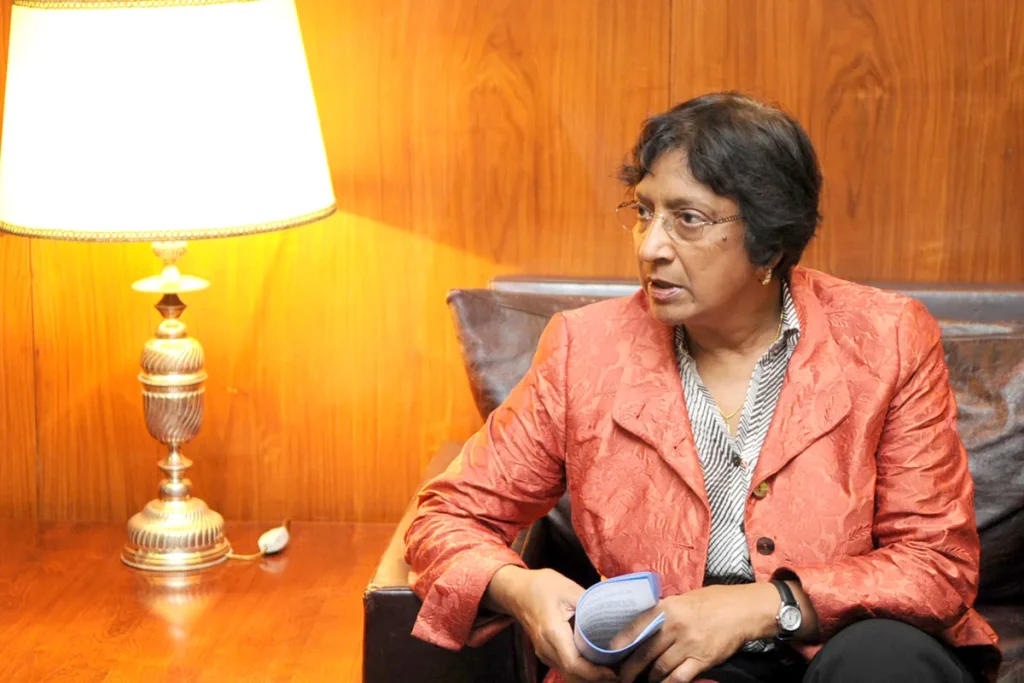
Antônio Cruz (Agência Brasil) / Wikimedia Commons / CC BY 3.0 BR
Navi Pillay in Brazil in November 2009, during her term as United Nations High Commissioner for Human Rights.